

So this is a real thing that I can hold in my hands now. I have a real, actual, physical copy of Parallel Prairies.
Maybe soon you will too.
Part-time prevaricator
So this is a real thing that I can hold in my hands now. I have a real, actual, physical copy of Parallel Prairies.
Maybe soon you will too.
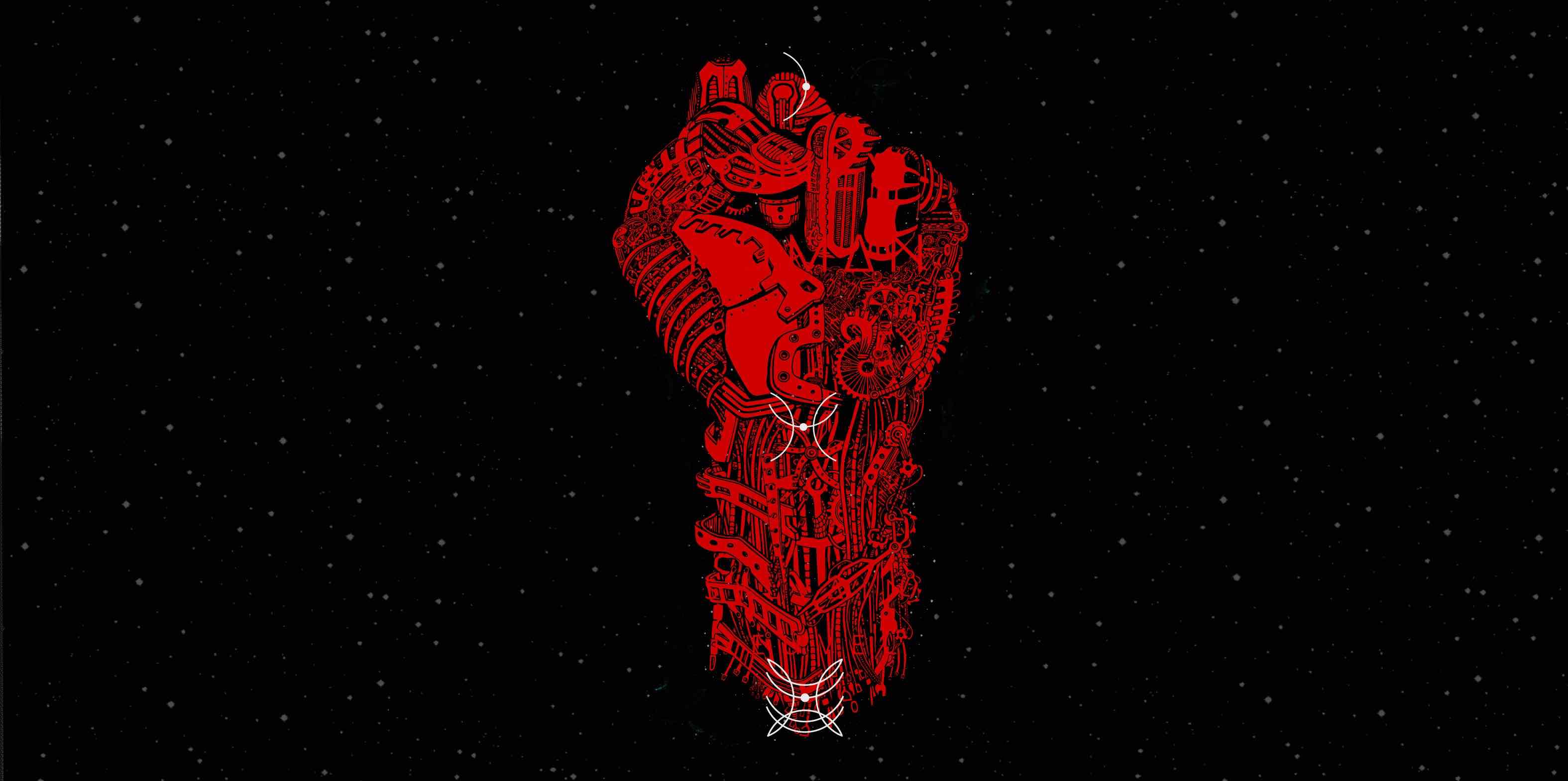
Thanks to my local library, I read Sylvain Neuvel’s The Themis Files trilogy:
As a young girl, Rose Franklin falls into a hole and discovers a giant mechanical hand. As an adult, she goes to work on what has now been named Themis: a giant robot of alien origin, which, for unknown reasons, traveled to Earth sometime in the distant past, only to be disassembled and scattered around the globe.
Along the way she teams up with a couple of military pilots, a man who claims he’s descended more or less directly from aliens, a rogue geneticist, and a mysterious stranger who wields more power than literally anyone else on Earth.
But no one’s ready for what happens when the robot builders show up. Or what happens when a handful of people are transported to the builders’ homeworld.
Turns out an invulnerable giant robot can have a profound effect on the geopolitical landscape.
The novels are epistolary, told in the form of transcripted interviews, news broadcasts, personal journals, letters, and the like. Sylvain Neuvel is a master of propulsive storytelling—I read books 2 and 3 in a couple of days apiece (normally it takes me between a week and a month to read a book), and the story itself had me laughing more than once. I especially enjoyed the tone of the Mysterious Stranger’s dialogue, even though he was sometimes not a very nice person. (There are no shortage of not very nice people here, and everyone’s flawed, just like the real world.)
The story examines the consequences of discovering that, not only are we not alone in the universe, but there exist aliens quite capable of wiping out the entire human race without breaking a sweat. How do you fight against a threat like that? And what happens when flawed human beings get access to that technology?
Well, you’ll have to read the trilogy to find out. Trust me, it’s worth it.
Highly recommended, especially if you’re into first-contact yarns, sardonic humour, giant robots, or geopolitics. Oh, and linguistics.

Update: The Brandon launch of Parallel Prairies will happen during Brandon University’s Homecoming celebration.
Update: The book now appears on the publisher’s site.
Sometime this fall, my short story “Vincent and Charlie” will appear in Great Plains Publications’ new anthology Parallel Prairies edited by Darren Ridgely and Adam Petrash.
My story’s elevator pitch is “ET, with a retired farmer with dementia in the role of Elliott”.
Pre-order from: McNally Robinson | Amazon.ca
Once I have more details about how & where to order, launches, etc, I’ll be sure to post them.

My Michael Swanwick chapbooks have arrived.
And they’re both great.
https://www.flickr.com/photos/pj/40294734025
I shot this photo from my deck, on a chilly night at the end of March 2018. Then I went inside and ordered Michael Swanwick’s chapbook/objet d’art Blue Moon, helping to ensure it would sell out instead of being burned.
Happy Hollow Bean, y’all.
…“And what is the purpose of this celebration?”
“To collect the all-important food.”
“Which is?”
“Candy.”

I recently finished my re-read of Gene Wolfe’s Fifth Head of Cerberus. Feeling pretty smug, thinking I’d caught a lot more than I’d picked up on first reading it, I Googled fifth head of cerberus analysis, which led me to a passel of articles on Ultan’s Library, including Proving Veil’s Hypothesis [warning: many, many spoilers] . And… wow.
I had no idea.
I still have no idea.
But I’m glad there’s at least one writer out there as subtle, as sneaky, as sly, as Gene Wolfe.

I went today to the Prairie Comics Festival. Reconnected with some writer friends (Chadwick, Sam, and Jamie), made some new connections (hi, Donovan), and regretted not bringing along my business cards (at least three people asked about WordPress stuff).
But I picked up a bunch of local art, so at least there’s that.
I look forward to a lot of reading.

Cross-posted on Goodreads, sans footnotes.
Every time I read a John Scalzi novel, I’m reminded what a good writer he is.* This one’s no exception. He handles the big picture and the small, personal details with equal deftness.
After I finished the epilogue, I jumped back to the prologue. With the knowledge of everything else that happens in the book, it was fun to see how this little piece of the story — largely unconnected to the events in the remainder of the novel, featuring characters we wouldn’t see again — still added to the whole.**
When I started reading the book, I wasn’t sure if it was a stand-alone novel or the launch of a new series. When I got to the end, it was pretty plainly the opening volume in a multi-volume set. (Don’t get me wrong — the novel is complete in itself, but the ending indicates there’s more to come.) Under normal circumstances, I’d have felt a twinge of irritation at this, but in this case I was relieved. I want more time with these characters, and I want to know just how they’re going to deal with an empire in collapse.
The Collapsing Empire, by John Scalzi
One final note: Peer review is important. Read the novel and you’ll see what I mean.
* In a lot of ways, John Scalzi’s writing reminds me of Joe Haldeman, who is one of my favourite writers.
** A note on prologues: Elmore Leonard famously wanted writers to avoid them, and generally speaking he’s right (IMHO). But any list of “rules” of writing are really guidelines, and usually reflect what works best for the author writing the list of rules. I’ve read a lot of Elmore Leonard’s detective novels, and I can’t recall ever running into a prologue there.
I don’t skip prologues when I read, but I do notice when they really don’t connect at all to the story. When that happens, I agree, it would have been better to excise the prologue entirely.
The Collapsing Empire’s prologue was fun enough — and connected enough to the overall story — that I read it twice.
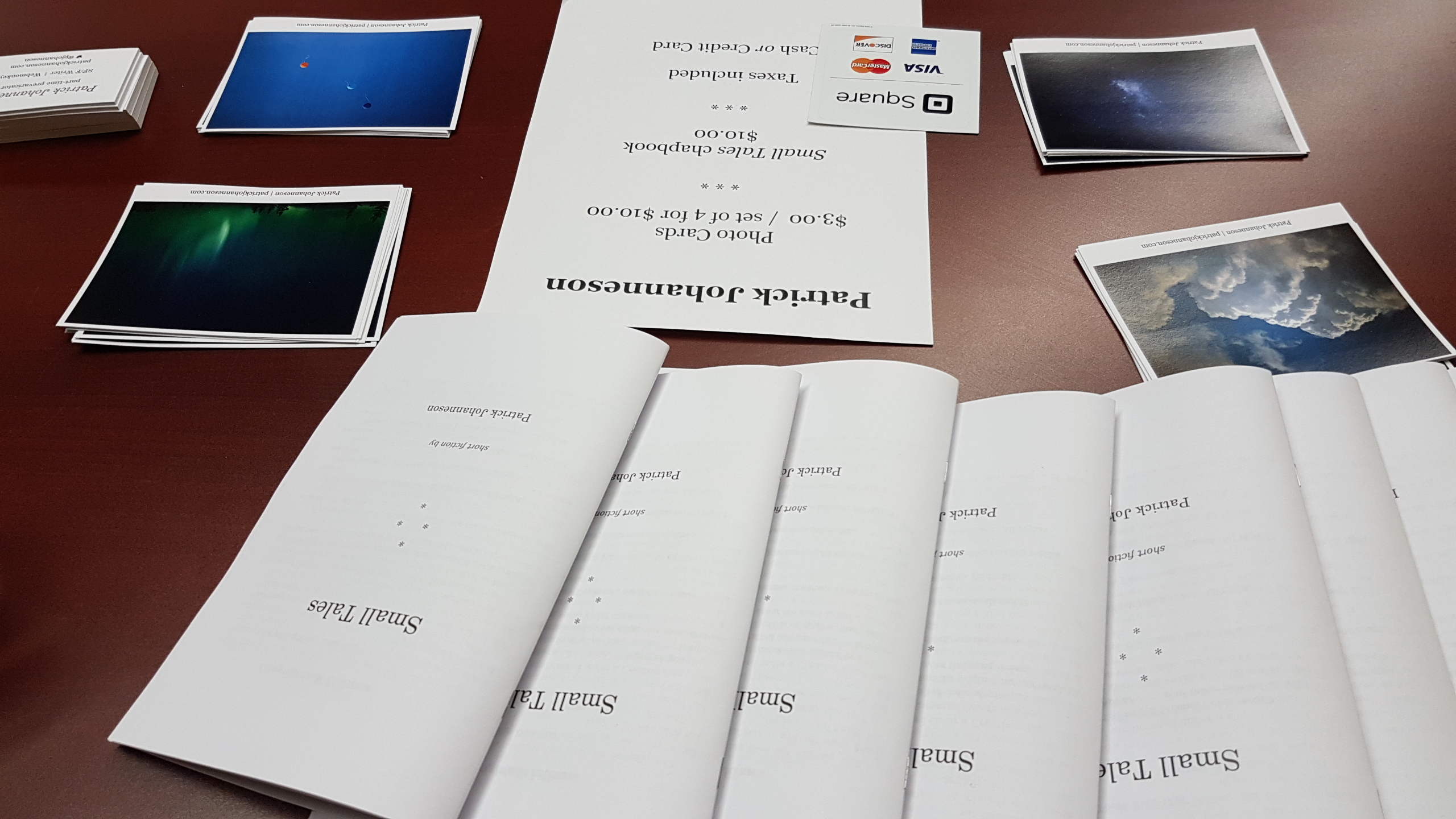
…at the ACI First Friday party.