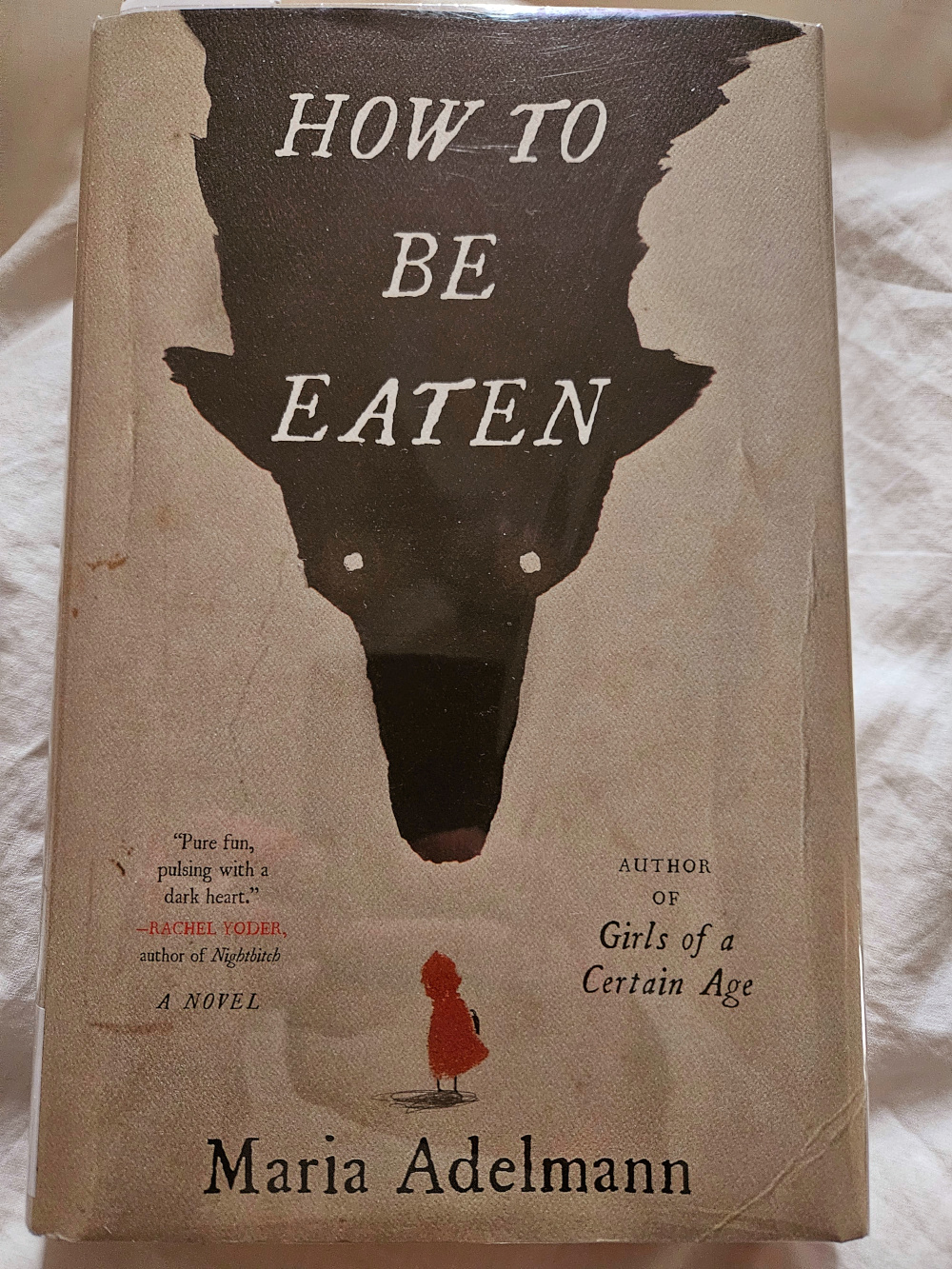
My local library had neither one of these books in the stacks. Enter ILL!


I bet I could probably get Gene Wolfe’s final novel, Interlibrary Loan, via ILL…
Part-time prevaricator
My local library had neither one of these books in the stacks. Enter ILL!
I bet I could probably get Gene Wolfe’s final novel, Interlibrary Loan, via ILL…

This line in Jo Walton’s The Just City struck me hard, and so I share it with you.
“There isn’t an end point to excellence where you have it and you can stop. Being your best self means keeping on trying.”
Apollo, in The Just City by Jo Walton

There’s a lot going on. But then there’s always a lot going on in a Gene Wolfe book.
This was my first read of The Land Across, and it’s going to require additional read-throughs for me to pick up on some of the puzzles. But even on a surface level, this book is very “all things to all people”.
Grafton, an American travel writer[1]Well, that’s what he claims to be, and why wouldn’t we believe him?, travels to an unnamed country in Eastern Europe, the land across the mountains, intending to write the first travel book about the nation. Very quickly he becomes entangled in the local law, Kafkaesque bureaucracy, and a conspiracy that grows to include a haunted house, at least one love triangle, a buried treasure, and a Satanic cult. Strange figures come and go[2]For example: was that Dracula?, seemingly at random. Some of the ghostly events turn out to have mundane explanations; others are in fact ghosts.
To quote one of the police officers in the first chapter:
“All maps are wrong. If the [enemies] come, they will be lost.”
—Gene Wolfe, The Land Across
I’ve found a couple reviews of this novel from 2013, when it was published: Charlie Jane Anders wrote about it for io9, and Mordicai Knode’s review for Tor.com suggests further reading—for instance, Flann O’Connor’s The Third Policeman.
I’ve also found this guide, full of spoilers, which I plan to use when I get to my second read of the novel. (This note is mostly for me, but if it helps you out too, I’m glad.)

It appears Hollow Bean has arrived again.
“They have an important celebration,” said E.T., “called Hollow Bean. Everyone carves faces in fruit squashes and dresses up in sheets.” Read more…
William Kotzwinkle, E.T. The Book of the Green Planet
B. good, everyone.
Photo by Fredrik Solli Wandem on Unsplash

I had a dream the other night. I was visiting a friend—I don’t recall who, but it might have been one of the Craigs I know—and, left alone in a room, I was looking over the friend’s bookcase.
I found on there a copy of The Elements of Style, colloquially known as “Strunk + White” after the authors. In the real world it’s a thin book, not much more imposing than a pamphlet; I’ve read novellas that are longer. But in the dream it was a trade paperback, probably 400 pages long, and I pulled it off the shelf. I used to have a copy, in the dream, and I thought maybe I’d lent it to this friend.
But if it was my copy, I hadn’t put my name in the front, which I usually do when I lend out a book. So I hesitated, contemplated taking it anyway, then decided not to risk it. I put it back on the shelf.
I don’t remember the rest of the dream.
When I searched the Internet for “Strunk and White”, I found this article from Mignon Fogarty, aka Grammar Girl, in which she lays out one reason why she doesn’t much care for The Elements of Style. (TL;DR: it’s a style guide that everyone treats like it’s a grammar book. In other words, it’s a set of suggestions that people instead treat like laws.)
As beautiful, haunting, funny, and brutal as the original novel. The art is amazing, and complements the story perfectly.
My review on Goodreads
I first encountered Kurt Vonnegut, Jr., when my roommate in first-year university was reading Galápagos in an English course. I read the novel and decided it was garbage¹. It just kind of… ended. I didn’t see the point. Vonnegut, I decided, was overrated.
Years later, I decided to give Vonnegut another try, and I read what is, in my mind, his most famous novel: Slaughterhouse-Five. Maybe it’s because I was older, maybe it’s because it was a straight-up antiwar SF novel, maybe it was because I knew better what to expect, but I loved it. I went on to read several other Vonnegut novels (Cat’s Cradle, Breakfast of Champions, Timequake), and I’ve loved each one. Vonnegut’s novels are different, I think, because they don’t generally have a villain. They’re just… the way things are.
So it goes.
And then I heard that Ryan North, of Dinosaur Comics, was involved in a graphic novel retelling of Slaughterhouse-Five, and I knew I had to have it. So I pre-ordered it from McNally Robinson, and it arrived last week.
It’s great. The two-page spreads of Dresden are, respectively, beautiful and horrifying. The story flows like a Vonnegut novel, and the art complements the story so, so well.
Highly recommended for fans of Vonnegut’s novels, graphic novels, or anti-war stories.
¹ When Kurt died and went to Heaven², I re-read Galápagos, and this time I thought it was great.
² At a memorial service for Isaac Asimov, an atheist, Vonnegut—also an atheist—said, “Isaac’s up in Heaven now,” because it was the funniest thing he could think of to say. So it goes. So it goes.

Today I finished reading How Rory Thorne Destroyed the Multiverse, by K. Eason, and I have to say, it was one of the best SF fairy tales I’ve read in a long time.
Continue reading “Review: How Rory Thorne Destroyed the Multiverse”
I came across this well-worn but still valid piece of writing advice on Twitter yesterday:
If you plan on subverting [expectations], you need to subvert with the goal of something BETTER.
And now today, on CBC’s Sunday Edition, they’re talking about Robert Munsch’s game-changing book The Paper Bag Princess, which came out in that long-ago era of 1980 and subverted all the expectations about what a fairy tale should be.
I remember discovering (or perhaps re-discovering) The Paper Bag Princess in my twenties. As a young man who had heard a million fairy tales with the “and then they got married” happily-ever-after ending, it was a very different ending than I was expecting: the princess doesn’t marry the prince, not even after rescuing him from the dragon.
It was a different kind of ending, but still a happy ending. Maybe not so happy for the prince, but then he did nothing to earn a happy ending. It subverted the trope and made a new, better thing from it.
So go: subvert the expectations. Subvert all the expectations. Make it better.
Header image: Maman, across the street from Notre-Dame Cathedral Basilica, in Ottawa.

Over on Twitter, Rosemary Mosco asked about books read and loved in the past year. I took a look at my list, and here are some of the highlights of the year so far, in no discernible order:
How was your year in reading?
I’m watching the first episode of George Clooney’s adaptation of Joseph Heller’s Catch-22, and I’m realizing I need to reread the book.