Items found in the pockets of a parka unworn since February:
- 2 hard candies
- Cotton gloves
- A Sportchek flyer from 2014
- A $10 Tim Hortons card with an unknown remaining balance
- $20
Much appreciated, past self.
Part-time prevaricator
Items found in the pockets of a parka unworn since February:
Much appreciated, past self.

Verdict: delicious.

So here I am in Winnipeg, ready for a class this Tuesday evening, and what shows up this morning? That’s right. A blizzard.
And it occurs to me: Will the instructor for the class be able to make it here from south of town?
Update: She did indeed make it in.
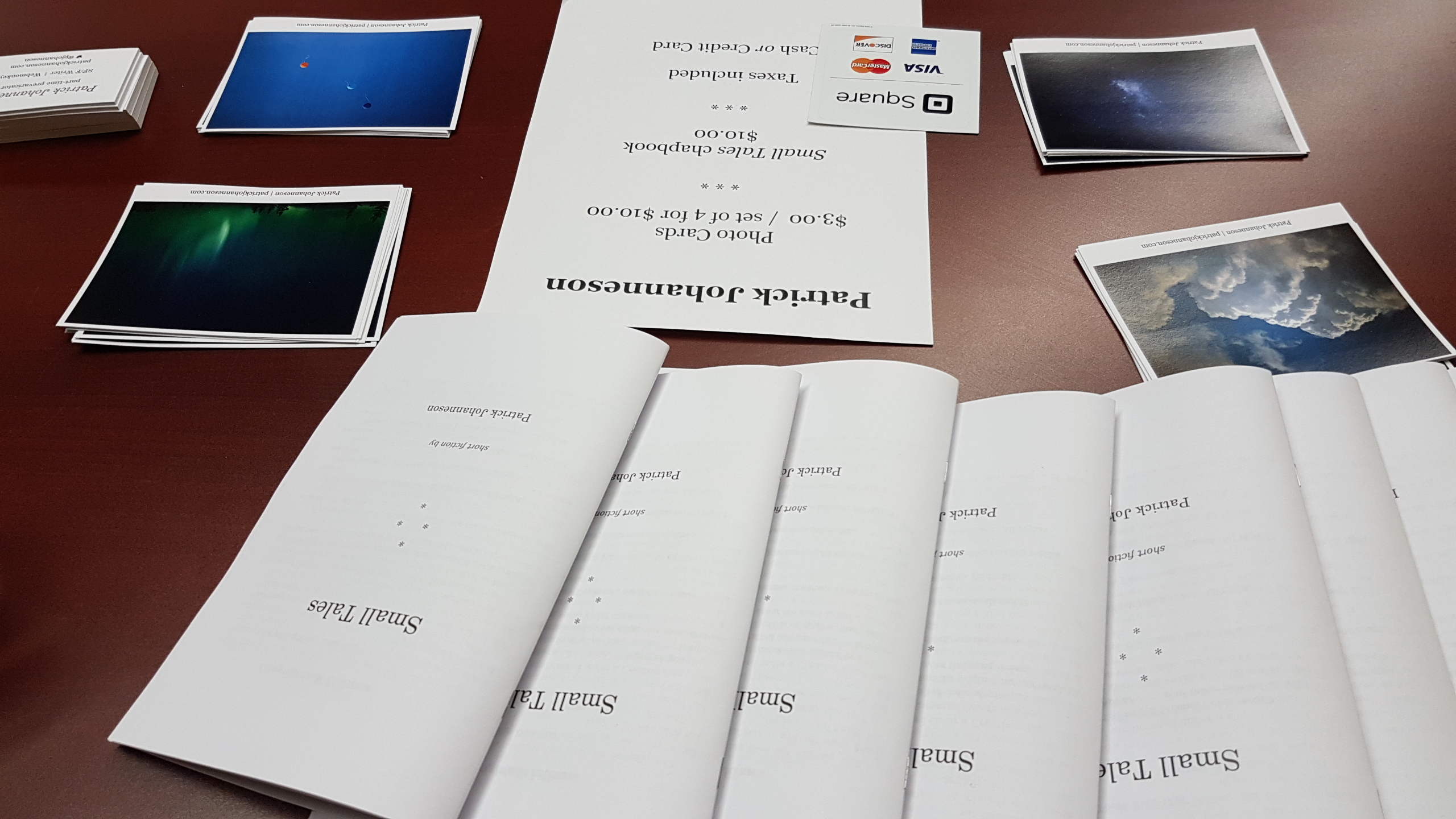
…at the ACI First Friday party.

This morning, before breakfast, I checked my email. One of my short stories, which made it into the second round at a publication (a rarefied space that, according to their statistics, only 10% of submitted stories ever enter), had been rejected.
So I moped for about five minutes—I’d had high hopes for this one, and now they’d been dashed—then had breakfast and prepped it for another market. (Always read the submission guidelines: the second publisher wants all trace of the author’s name scrubbed from the submission, to allow blind judging.)
Moral: If you’re an author, get used to rejection. But don’t let it get you down.
As ever, Kurt Vonnegut’s simple quote applies here: So it goes.
Here, have a ridiculously toe-tappy earworm:
When I went to see Les Claypool when he played Winnipeg, I was pretty thrilled when he opened with this little ditty. It’s long been a favourite of mine. I hope you enjoy it too.
In the shower, I had a moment of insight, an epiphany, about the connection between the situation my main character faces at the end of the story and the situation his sister faces all the way along. It might even inspire the title of the third act, but let’s don’t be hasty.
From the little-known sequel to E.T., penned by William Kotzwinkle:
“They have an important celebration,” said E.T., “called Hollow Bean. Everyone carves faces in fruit squashes and dresses up in sheets.”

Fellow Brandon author Craig Russell recently had a new novel published, titled Fragment. I went to the book launch at McNally Robinson Booksellers and bought myself a copy.
I finished reading it last night, and I must say, I enjoyed it. It’s a short novel—not much over 200 pages—but it packs a lot into that space.
Thousands perish as ice overruns a research/tourism base at the south end of the world. A massive sheet of Antarctic ice—the Fragment—breaks free of the continental ice shelf and drifts into the ocean. Three scientists, survivors from the destroyed base, must try to get the message out: This is a disaster. The Fragment threatens thousands, possibly millions, of lives.
Standing in their way is the captain of the nuclear submarine that rescued them, under orders to run silent, run deep. Also, the President of the United States isn’t thrilled about the situation, since it looks like it’ll be bad for his polls in the run-up to re-election.
And Ring, a blue whale, tries to warn his people of the dangers presented by the Fragment. But he’s only one voice in the vast ocean.
The story is captivating. Russell1 does a good job of fleshing out his cast of characters, especially the ones we’re going to spend a lot of time with. Ring in particular felt like a well-developed person, who just happened to be a whale.
The stakes start out high and get higher all the time. I couldn’t stop turning pages, especially in the last half of the book, which I read in a single sitting.
The ending, while compelling, felt like it could be fleshed out somewhat. Several disasters involving the Fragment’s unstoppable force vs. an island’s immovable object were delivered in a few paragraphs, and it felt rushed.
Buy it. Read it. It’s an eco-disaster novel with political overtones, and it’s a first-contact novel, all in 200-and-a-bit efficient pages.

Along with my collection of six Very Short Stories, these are the works in Word-o-Mat’s Edition #1:
Information about all the authors may be found on the Word-o-Mat website.